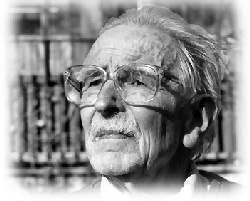
| Images of everyday life The words of Paul A.Smith-reproduced by kind permission of The Marshwood Vale Magazine where this article appeared in March 2007 ,just before Paul's death later in the month |
|
Photograph by Fergus Byrne |
| ‘As the Great War ended my parents got married. My dad
was a tenant smallholder with land around Westhay on the Somerset Levels.
Mother had returned after life as a Nursery Governess around the World but
finally in France and Denmark. She was in Paris when Big Bertha was firing
into the City. In 1919 we twins were born. Our farmland was split up and we moved to an isolated farm on Windwhistle Hill once part of Lord Bridport’s Cricket St Thomas Estate. Life was very primitive. Lighting by candles, wood fires, no road in just a track, horse and cart transport, cats-whisker wireless, no telephone. A Newspaper once a week. Mother had two illustrated books of fairy tales, Grimm’s and Hans Anderson’s. She also told us exciting stories of her life in India and South America. When she taught us to read, I decided to ‘do books’! At six years old we walked a mile to a neighbouring farm where a teacher taught their young family. At eight years old Mother got us into Chard School. Day-boys in a boarding school and barely tolerated. Farming was not thriving and at 14 I had to leave school and replace our last farm worker. It was heavy work feeding and mucking out cattle, pigs and poultry. Learning to hand milk and driving our two horses. No pay or days off. But I soon found I could earn money from the wildlife. Mushrooms, nuts mole-skins, sloes, crab-apples and netted rabbits. Cricket Estate had the pheasant shoot and a trapper had the snared rabbits. I also did a short correspondence course on ‘Commercial Art’ after dark.The starting of the Chard Young Farmers Club came to my aid. Members each had a calf to rear. There were talks on farming practice, public speaking, holding meetings, and we visited other farms. There was the ‘Young Farmer’magazine. At 16 I won a prize for an essay and they also published some of my cartoons. The chief of Yeovil School so as soon as I got a car driving licence I spent one short mid-day period each week in their ‘Life Class’. The farm work was either end. By 1939 the War Clouds were gathering. Young rural lads were the infantry, cannon-fodder of the last War, so a local farmer’s son advised me to join the territorial West Somerset Yeomanry (Field Artillery) at Taunton. I, and a fellow ‘farmer’ (later Colonel Dick Eames), took the last two vacant places. Here I did a compulsory camp on Dartmoor and several weekly ‘drills’at Taunton. I was paid with car allowance. I was called up when WW2 started. We moved to Holesworthy in Devon to do a years ‘phoney War’. So I joined as mall group called ‘specialists’. They did all the technical part of gunnery at every position... and drew panoramas. We had to use log. tables checked with slide rules. Calculators had not been invented. This was also the way to become an artillery officer and we lost very many so that I was at times alone and was left to read the large ‘Manual of Artillery Survey’. One friendly Officer also made me understudy clerking jobs...pay clerk, rations calculations, medical records and paying out the billeting landladies when we were in Devon. Thus I even avoided roll call. After several months we got a full team of Specialists. We built a raised landscape of sacking, wood and lufas. Here we played ‘firing practice’ games. We also made a complete set of Battery vehicles with matchboxes. We also did surveys around the Town or out on the Moors. It was, to me, all great fun. The War really started when Hitler started to take over France. The time of Dunkirk. We suddenly moved into an old mansion in the Ashdown Woods near Grinstead. Until we got twelve guns around New Romney I ran a Battery shop. Selling papers, cigarettes, sweets, fruit. For a time I slept on ammunition boxes behind the serving window with the loaded Bren Gun at my side. Finally with twelve guns in three Troops I was forbidden to accept other jobs and only do ‘specialist’ work. I also started a four-year farming correspondence course which I did at the survey table. I also greatly enjoyed watching the German big guns firing and the French coast at night for the armoured top of Popes Hotel at Littlestone. Four of us used to play tennis, in tin hats! when we were free during the fine afternoons. We thus got a front-line view of all of the Battle of Britain. When in the town enemy planes would search for targets. If not on duty we were ordered to lie face down in slit trenches we dug near bushes. This was boring so I was admonished for using white paper to write a competition essay and so I wrote it on Khaki army toilet paper to win a prize from the Guild of Agricultural Journalists. When we were doing coastal work around Norfolk the Army started to seek out men who had civilian skills. We lost several ‘specialists’. So when a big poster was asking for volunteers for Radiolocation. I used by ability for’ fairy stories’ to fill in a long application form. Our Major kindly agreed to recommend me if I insisted. On 1st Feb 1942 I suddenly left night maneuvers and went to the Municipal College Bournemouth to do a four month (later five) preliminary course before the secret course at the Radio School, North Berwick, and the formation of the RMEM. Here I enjoyed learning in rooms with blacked out windows, behind locked and barred doors and with lethal voltages. Books on chains. As a radar mechanic I qualified for another course. I volunteered to do my field study at Scapa Flow (Orkney). A dream world for a naturalist like myself. Here I also did a short balloon course with the RAF. I loved the Orkneys and asked to be sent back. Then back to college. This time University College, Nottingham. After three months I qualified for Advanced Radio School at Gobsall Hall, near Birmingham. Then back to my beloved Orkney. Rated ‘overseas’, we got doubleleave, free cigarettes, extra rations, and a daily tot of rum as a site mechanic (telecommunications) on heavy AA Gun sites. Here I also finished my farming course, did a London matriculation course, did cartoons for Unit and Schoool wall newspapers. I had my own stage act and gave some talks. I also did a short Army teacher training course. I had to go back to Radio School when new inventions were made. There I stayed until the War ended. Nearly seven years before I returned to farming. Back at the farm my parents were over seventy and the farm needed an overhaul. I was chairman of the Young Farmers when I left and by 1948 I was chair of the Chard NFU Branch and their Delegate to Taunton County. I now married Monica who knew our Wartime farm. She had done a year course at Cannington Farm college and was living with her parents while working at the United Nations in Paris where she was born. With farm and committee work I found I was serving on 19 local committees and working some 16 hours a day. Ultimately my body rebelled and I found I broke out into spots at meetings. Doctors could not cure me... My friend the late Alec Adams, who ran a school at nearby Forton, suggested I must learn to relax, he was forming a Judo Club and I joined. I had to resign from my committee work. It certainly cured my spots and I was going for my brown belt - one below black - when a tractor accident shortened three fingers of my right hand. I was nursing a bandaged hand at the farm when Peter Tolson, one time County NFU Secretary, called and got me to join (the now) Somerset Nature Trust. And booked an article of mine for their magazine.During that weekend I wrote three articles, all sold by return. I was also soon in the air from Dunkeswell Aero Club. I got my Private Pilots Licence the day I became a grandfather. I flew for twenty years selling my articles with photos by my wife or Colin Kearl. I reckoned to have learnt to fly and flown at very little cost to myself. Planes cost £7 an hour to hire when I started. I covered the Counties of Devon, Dorset and Somerset with several hundred articles. The day came when my two sons did not wish to farm and both of my daughters had married non-farmers. We sold the farm and moved to a bungalow in Winsham village. I felt ‘lost’, my farming articles would dry up. So I immediately joined the Open University to do an extended degree in Natural Sciences (Geology, ecology, biology and evolution, and also sociology and modern art). I did twelve summer schools at Universities and a research centre. I got an Hons Degree at age 73. I had to forgo a second degree in sociology as my wife was ill and I had set up as a Book Publisher (Wolfgang Publishing) and was just finishing my third illustrated book. This last published when I was eighty - sadly just as my wife suddenly died after fifty years of marriage. Winsham is a very active village and has got its own Museum on the Internet. I have done the illustrated sections on Farming, geology and natural history. I also write a monthly illustrated commentary on the Winsham parish Wild Life for the Council. I use my car, electric bicycle and two folding buggies to explore the West Country - especially the rivers and canals. I hope to get back to regular article writing to add to the 600 plus items already in my scrap books. My family, including now thirteen great-grand children, is ever growing, but I need many more active years. Mother’s brother uncle was 104. So I am always happy and optimistic. All my life I have been able to find homes for my odd writings and drawings. I have kept to my childhood wish to ‘do books!’ |