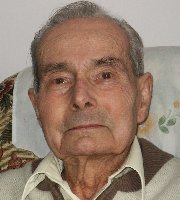
Fred ,until his death in
2005,lived in Davies Close
Winsham at War |
Memories |
|
Fred ,until his death in
|
The
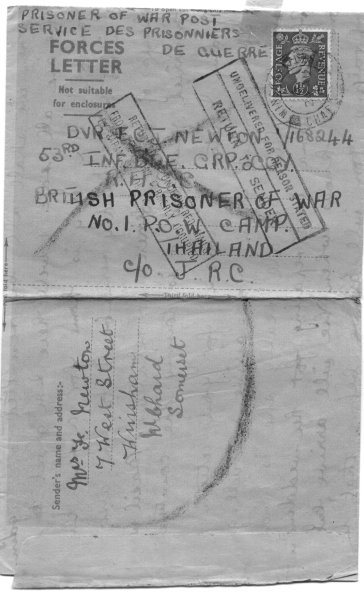
Story of Fred Newton -Private RASC British prisoner of war number 1004
captured by the Japanese in the fall of Singapore. During his period of
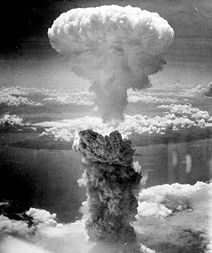
captivity he saw the Atomic Bomb dropped on Nagasaki .
|
|
.
After a period working in Singapore itself, repairing lorries which
had been sabotaged before the Japs arrived, Fred, with thousands of other
prisoners was sent to Thailand to work on the infamous railway planned to
connect Bangkok and Singapore to the existing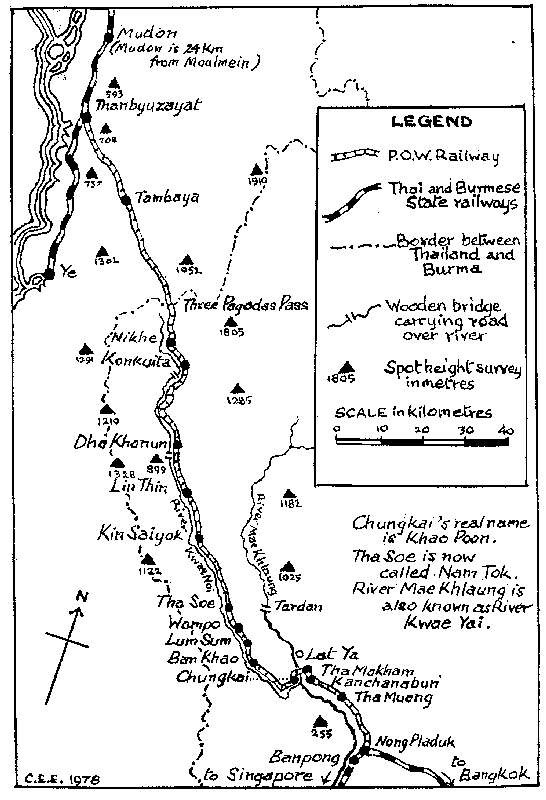 Burma railroad. (Click on map) Burma railroad. (Click on map) |
|
Six
of us used to go out from there - we palled up together in this company
from England stuck together all through and we used to go up into the hill
and collect bamboo for the fires to cook the rice. They’d give you a big
board to hang round your neck with Japanese slogans to say that you were
permitted and we used to see these little kids coming along in the
mornings with these bunches of flowersand put them on the graves.When the
wife and I went out in 1995 I was telling her about that and there were
two little girls inside the cemetery and they saw me standing in front of
the grave that I found which was one of our mates - he died; he had both
legs amputated. He died on
Christmas Eve 1943,and they saw me standing there I suppose I broke down a
bit Next thing standing beside me,they gave us some flowers and pointed to
put them on that grave. That
was very touching indeed. . Reminded me of those children going up to
where the graves were - they’ve been moved now into the cemetery.” |
Fred remained in camps Nong Pladuk
and Kanchanaburi until April or
May in 1944. At this time he and his mates decided to volunteer to be sent
to Japan, thinking that they would be more likely to survive there when
the Japs were ultimately defea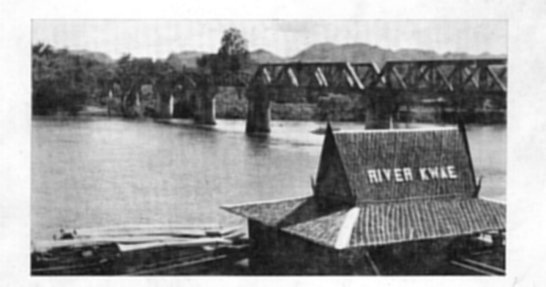 ted as nobody knew what they might do to the
POW’S in Burma and Thailand. ted as nobody knew what they might do to the
POW’S in Burma and Thailand. Transfer to Omuta, nr Nagasaki In Japan he was sent to the infamous Camp 17 at Omuta across the bay from Nagasaki on the southernmost island of Japan. There he worked in a zinc foundry where zinc scrap was melted down for re-use. Japan: |
| Tip it down a great big pit get a new
one and put back, tripped over something - you couldn’t help it - things
lying about all over the place We tripped over it and fell down and of
course the Japs went mad about that. It was an accident, you can’t help
that. Hurt my hip and was sent to the physiotherapy room. I laid on the
table there, then they said they were going to send for someone. When he
came in - great big bloke ,about six foot something ,tall hefty great
bloke I don’t know if you’ve watched all-in wrestling . . . Leg
stretch . . so he got hold of my leg, he put it right over . . Walked back
behind me and went Phew, Gee whiz, that did hurt. Think if he’d left it
where it was ! Done a few exercises would have been better off because it
did hurt. Any way they had to send me home on a tram.
You had to march home when you finished work. An extra guard was
put on the tram with me so instead of walking back I had a ride home.
So I was off - couldn’t work for two or three days after that
when it got better it was all right, it was painful that was. . . Then I
burnt the bottom of my foot - they gave me rubber shoes. The Japs pinched
all the Red Cross parcels . . . . . .trod on a hot cinder - burnt right
through.” |
|
In
Camp 17, when the meager rations were handed out to the prisoners, there
was a pegboard with each man’s number on it by a hole. When he received his food, a peg was put in its hole to
ensure that no man was given more than one ration. After returning to camp
at the end of the days work at the foundry, Fred lined up for his food,but
an American orderly who was handing it out said that his peg was already
in the board and so he must have had it.
Fred insisted that he had not but the orderly threatened to report
him to the Japanese so he gave in.
Later he encountered a British officer. One Geoffrey Pharoah Adams
who listened to his story and marched back to the canteen area with him,
out-ranked and out-faced the corrupt orderly who was forced to concede.
Many years later (Capt?) Adams who wrote several books about his
experiences as a POW was in contact with Fred who he remembered well as
the Prisoner No 1004 who he had helped at Camp 17. |
| “We were
just across the bay from Nagasaki .
. . it turned out it was April 29th because it was bombed -
incendiary bombs - it
was all they needed in Japan really- incendiary bombs - everything would
go up in flames . . . Unfortunately, the wind was blowing that night
- blew some of them over into the camp, set that on fire but they
did drop two high explosive bombs one went off and one didn’t detonate.
They got an American and made him pick that up and walk to the
water edge and dump it over the side . . .Anyway, he was lucky it didn’t
go off. We had one or
two scares after that . Eventually
we knew something was happening, the Japs came round and gave you a good
beating for nothing . . . So they were losing . . . .One day we saw this
huge cloud go up from across the bay and we all said oh they’ve hit the oil places
over there . . because we knew Nagasaki was a big naval base . .
. We heard a few days afterwards that that was the second atomic bomb. And then we heard that we were being set free but
we had to stay where we were. The Japanese had moved outside the camp and
we had to remain . . I should
say there were about 4000 of us - there were Americans, Dutch, British and
some Indians... . . .” |
|
“We just marched out down to the railway station. We were
taken by Nagasaki and we could see the result of the atomic bomb - nothing
standing, only the railway line, that was okay .Trees uprooted, just blown
right out of the ground and planted somewhere else . When we were boarding
the boat a USS mobile cruiser
and the American sailors
there . . A nice big old-fashioned scrubbing brush
a bar of carbolic soap and we were scrubbed from head to foot.. I
imagine there were about six to eight hundred of us on that boat. We were
in a very poor condition. They give you three options- to fly back ,go by
boat or go by train. I volunteered to fly back but no - they’d keep you
hanging about because when I left Japan I was between eight and nine stone
- before that (in Thailand) well down
below eight stone’’.... |
|
‘We
were taken down to Okinawa, from there we flew to Manila in one of the old
Liberators, which had just been taken out of action - the bomb doors
didn’t close properly . We sat there looking down at all the little islands . . Then
we could go up in the cockpit, take it in turns, go back to the rear
gunners place have a look there, it was quite exciting.
Came into Clark’s Field in Manila and into another plane to fly
us across to another little airport and then on board the Implacable - the
aircraft carrier. It took us to Vancouver in Canada and then from Vancouver
I came all through the Rockies. Three days and three nights on the same
train right across to Halifax. By the time I reached Halifax I had
completed an around the world trip. (originally he traveled via Halifax
to Cape Town and Mombassa to
Singapore). I shall never
forget that journey through the Rockies .” |
|
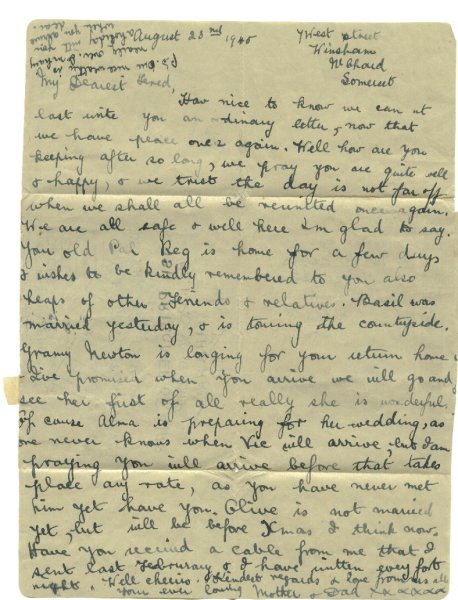
Fred was reported missing and every card that his Mother had sent
to him over those three and a half years was returned as ‘not known’.
The first word from him in all that time was a cable sent by him
from on board the Implacable.
|
|
‘By the time I got back to England back to Southampton on
the Isle de France I weighed 13
stone ten, On that Canadian train . . Beautiful. . . Same train all the
time, they changed the sheets and bedding . . Marvellous trip . . I always
wanted to go back. Unfortunately
I left it too late. Can’t
make it now. .’
‘Landed at Southampton, couple of days there, sent me home on
leave, after Christmas I had to report back to Trowbridge a couple of days
there and then they sent me to Taunton for demob. We had our passes late.
I had to get a later train and got to Chard Junction at three o’clock in
the afternoon. Among those who
pulled the car up through the village was Gwen,a girl in the WAAF who Fred
had known from school days when he used to work the bellows on the organ
at Sunday School and she used to sing in the choir.
‘I used to give her a
wink every now & then when
I was on the organ, so I made up my mind then - you know - but it took a
long time. We both went our own ways, but I came back & she was one
of those helping to pull the car up through the village. We got chatting & I found that she was still free
& still eligible so it started all over again’.
Gwen
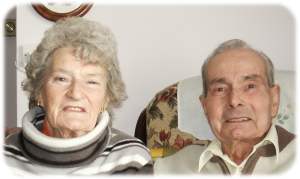
& Fred Newton were married 1947. Fred passed away in 2005 Copyright
reserved by Fred Newton & Peter Duffell |
Click Here to Return