|
 On
July 22 in that year Haig launched the preliminary bombardment
of the German lines by some 3000 pieces
of artillery
which turned the battlefields into a vast swamp in which a man
who slipped off the duckboards would most certainly sink down
to die in the mud and filth. Haig still, it seems, believed in
the fantasy of a glorious cavalry breakthrough and the
disaster of the Somme and thirty six months of warfare seemed
to have taught him nothing.' We died in hell, they called it
Passchendaele’ wrote Siegfried Sassoon and it is said that a
senior staff officer named Lancelot Kiggel visited the front
when the fighting was over and burst into tears saying ‘Good
God! Did we really send men to fight in this?’
He might also have asked ‘Why did we let Haig do
it? On
July 22 in that year Haig launched the preliminary bombardment
of the German lines by some 3000 pieces
of artillery
which turned the battlefields into a vast swamp in which a man
who slipped off the duckboards would most certainly sink down
to die in the mud and filth. Haig still, it seems, believed in
the fantasy of a glorious cavalry breakthrough and the
disaster of the Somme and thirty six months of warfare seemed
to have taught him nothing.' We died in hell, they called it
Passchendaele’ wrote Siegfried Sassoon and it is said that a
senior staff officer named Lancelot Kiggel visited the front
when the fighting was over and burst into tears saying ‘Good
God! Did we really send men to fight in this?’
He might also have asked ‘Why did we let Haig do
it?
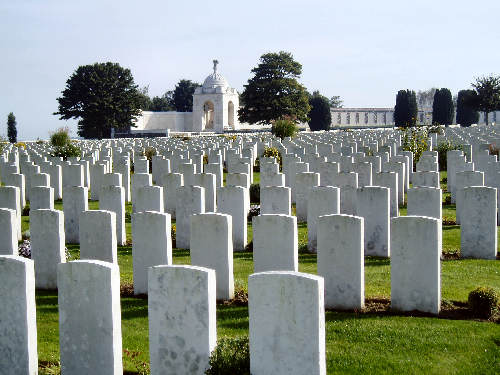
On our first morning we went to
the enormous Tyne Cot cemetery on the Passchendaele Ridge
where the names of 35,000 soldiers with no known grave are
inscribed on the long white marble wall which backs the
cemetery. One of our neighbors in Winsham - Mirabel Hunter -
had told me of an uncle of hers who had died at Passchendaele
and we had promised to look for his grave at Tyne Cot. He was
a lieutenant in the Northumberland Fusiliers who had left many
men at that place and legend has it that it was the
Northumberland Regiment who had christened the ridge Tyne Cot
because the German pillboxes silhouetted on the skyline
reminded them of cottages at home.
|

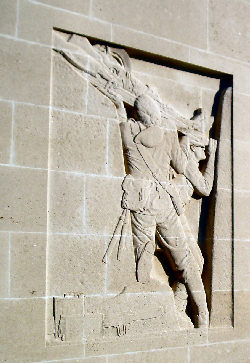
Memorial at Tyne Cot
Cemetery |
But of course, Second Lieutenant James
Angus Scott had no grave; he was just one of the thousands of
men listed on the marble wall which backs the cemetery who had
been blown to bits
or lost in the mud to be eaten by rats -
for whom the ‘fortunes of war’ as the inscriptions everywhere
in Flanders and Picardy put it, ‘denied the known and honoured
burial given to their comrades in death’. We found Lt. Scott’s
name and I dutifully took photographs of it and the thousands
of gravestones of unidentified soldiers. Perhaps one of them
was his but as the inscriptions have it, he and all the rest
are known 'only to God'. To us they are The Missing, of the
three battles of Ypres, the Somme and all the other fields of
death whose names resonate in the memory; Mametz Wood, the
Messines Ridge, Vimy, Cambrai, Hill 60 and so on.
Nearby, was the Passchendaele
Museum with the inevitable reconstruction of a section of a
trench and dugouts. At a place called Hooge, there is a
enormous mine crater in the grounds of a hotel and nearby a
small museum claiming to be the best private museum in
Flanders. It houses among other things a copy of a German
Fokker DR1 Triplane, the machine flown by the Red Baron von
Richthofen and one of the war planes that I modelled as a
schoolboy, along with the SE5s and Sopwith Camels.
Also nearby is Sanctuary Wood, another private museum
the owner of which, one Jacques Schier, would probably contest
the Hooge claim to be the best. Behind it is a preserved
stretch of trench on the Schier property and it costs six
euros to visit it. The entrance is through a shabby shop and
cafe with Coca Cola signs and souvenirs for sale. The owner,
we gathered, is scathingly called ‘Jack Money’ by the locals
who are not profiting so well from the war industry. Part of
the attraction of the Schier museum is a collection of wooden
stereoscopic viewing devices which can be used to view a
collection of horrific war photography - pictures of bodies in
trees, heads and limbs and dead horses in the mud. Major Holt
says these photographs are a must - ‘the true horror of
war - dead horses, bodies in trees, heads and legs in trenches
and everywhere mud, mud, mud.’ The Canadian writer Stephen
O’Shea calls them war porn and finds the act of pouring over
these photographs repulsive. We did not look at them, but I
suspect that if I go back again to the Western Front, I will
have to. .
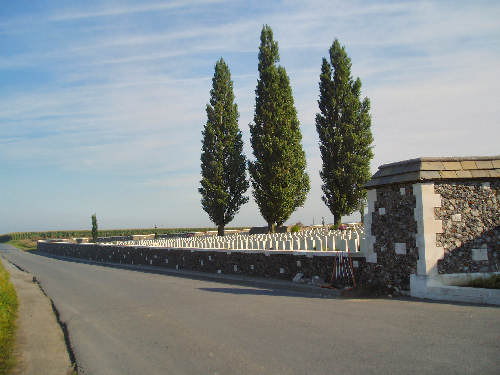
Entrance to Tyne Cot
Cemetery |
Not far away is Hill 60 once the most visited place on the
Flanders Front. It was actually not a natural hill at all, but
a mound created from the rubble from a nearby railway cutting,
but now,
 the trenches which for years were sandbagged have
filled in and one walks around a series of grass filled
cavities and mounds and memorials. the trenches which for years were sandbagged have
filled in and one walks around a series of grass filled
cavities and mounds and memorials.
The facts are there to be read
and understood, but there is little to feed the visual
imagination. There was prolonged tunnel warfare at Hill
60 from February 1915 onwards and many of the men who died
there are still there under the ground. It is a mere 60 metres
above sea level, but classifies as a hill in ‘le plat pays’.
In 1992, some 5 kilometres from the centre of Ypres, a section
of trench was discovered by chance. It is called the Yorkshire
Trench and some 70 metres of trench have been restored and
preserved. We
took the straight and rather characterless road from
Poelkapelle to Langemark to visit it. In O’Shea’s book we had
read that, in 1914, it was on both sides of this road.
thousands of untrained young student volunteers, sent to these fields by the German
general staff when the planned Race to the Sea was not going
to
Tyne Cot Cemetery
plan, had died in a ‘Massacre of the Innocents’.
Marching into battle as thought they were on Sunday
hiking outings, singing with linked arms, they were mowed down
by British machine gunners.
The Germans called it Der Kindermord von Ypern and
and in Langemarck, there is a
Germany cemetery with over 44,000 bodies many in massed
graves. The Yorkshire Trench is incongruously in the middle of
an industrial development. and it was very easy to drive past
it . Reaching the next crossroad, we realised we had done just
that and turned back There are new duckboards for one to walk
the length of the trench and peer down into the two dugouts
which are full of water. The surrounding sheds and industrial
buildings militate against any real atmosphere and there was
no sign of any other visitors. One can do little but read the
information boards and take in the fact that it was in this
sector that a new kind of duckboard was designed which made
walking down the trenches marginally less unpleasant for the
poor bloody infantry who occupied them.
The city of Ypres itself was, of course
totally destroyed during the war, but never fell to the
Germans. Winston Churchill, famously said of Ypres that ‘a
more sacred place for the British race does not exist in the
world’ and he wanted the town to be left in ruins as an
eternal monument to the million men who fought in the Salient.
The people of Flanders, however, had other ideas and recreated
the city and its famous Cloth Hall in the city center. The
Cloth Hall houses the war museum and, as one enters, one hears
the voice of the folk singer June Tabor. Will ye go to
Flanders my man? she sings and one walks through the
rooms to the sound of voices, and music; J McCrae’s In
Flanders Field and Wilfred Owen’s Dulce et
Decorum Est are mixed with recordings recreating the
verbal testimony, in Flemish, English, German and French, from
men and women who were there.
It is no celebration of glory or sacrifice, no sentimental
patriotism, simply a threnody for wasted lives. McRae’s poem
was written in 1915; Owen’s in late 1917. The change of tone
is dramatic; In McCrae’s poem the dead ‘saw sunset glow’ and
‘lie in Flander’s field’ and they implore us to ‘take up our
quarrel with the foe’. which critics have since condemned as a
deplorable jingoism. But, two years later, the fields had
become a sea of filthy stinking mud and Owen sees a man
drowning, 'the white eyes writhing in his face’, with ‘froth
corrupted lungs’. The sentimentality of Rupert Brooke and John
McCrae is no longer acceptable and yet McCrae’s poem had a
staying power along with other First World War clichés like
‘It’s a Long Way To Tipperary’ and ‘Over There’.
That
evening, we did what all visitors to Ypres do. We went to the
Menin gate where at eight o’clock every night, the Last Post
is played. Often
as Stephen O’Shea found when he was
there, there are only a few curious people but on this
particular September evening, there was a large crowd.
Moving amongst them were a group of Englishmen all dressed in
the same green blazers; they were a male voice choir from
Sheffield and they were part of what turned out to be a
ceremony of some proportion.
Speeches
were made by various town worthies, the choir sang ‘Silent
Night, Holy Night’
and the English National anthem.
Along with the Belgian trumpeters, was a tall grizzled
old kilted Scotsman playing the bagpipes providing a drone
accompaniment to the buglers of the Last Post. Of course, it was impossible not to be
moved to tears by the moment, despite a feeling of guilt at
what might be simply a
personal indulgence. Ones eyes turned up to the thousands more
names of the missing inscribed on every surface of the
memorial - fifty-five thousand of them, regiment by regiment,
from Britain South Africa and India
and among them, as O’Shea
noted, the names of men from regiments raised in India.
Everywhere in Flanders and Picardy there are these lists of
the fallen, ending sometimes with the word Addenda carved
followed by a few extra names, which somehow or other had not
been included in the original count.
Newfoundland Park
If there
is one place where it becomes almost easy to actually
visualise the Western Front as it was, that place is
Newfoundland Park on the Somme - where, on 1 July 1916 the
First Battalion of the Royal Newfoundland Regiment went into
action and, in less than half an hour, suffered what was
probably the highest casualty count on that terrible day.
The land was bought by the then Government of
Newfoundland, an area of over eighty acres with many preserved
trench lines through which it is possible to walk.
Where only a small section of trench or crater has been
preserved, often with its nearby cemetery of French o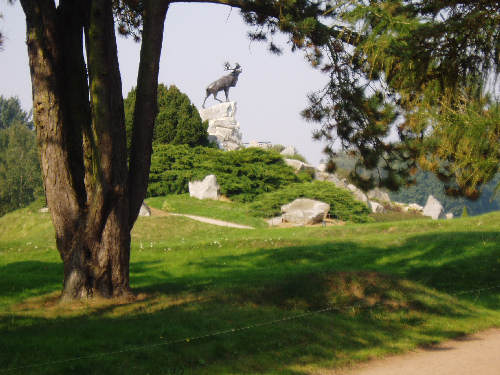 r
Belgian, British or Canadian, Australian or New Zealanders, it
is not easy to do more than take in the depressing facts.
Here, in this large memorial ground, it is not
difficult for the mind’s eye to, as it were, dissolve out the
memorials - the Caribou emblem of the Newfoundland Regiment and the
kilted Highlander of the Scottish 51 Division, and
visualize the sandbags, the wire, the mud and the blasted
trees perhaps even the ghosts of the men who fought and died
on the Somme, who we have seen so often in still photographs
and silent film, in museums and television documentaries. r
Belgian, British or Canadian, Australian or New Zealanders, it
is not easy to do more than take in the depressing facts.
Here, in this large memorial ground, it is not
difficult for the mind’s eye to, as it were, dissolve out the
memorials - the Caribou emblem of the Newfoundland Regiment and the
kilted Highlander of the Scottish 51 Division, and
visualize the sandbags, the wire, the mud and the blasted
trees perhaps even the ghosts of the men who fought and died
on the Somme, who we have seen so often in still photographs
and silent film, in museums and television documentaries.
Theipval Memorial
Suddenly one felt suffocated by lists; lists everywhere, on
memorials, names, names and more names of so many
nationalities.
Thiepval, the largest British War memorial in the
world, has even more names than the Menin Gate, over 73,000 of
them under the simple bald inscription
The Missing of The Somme which was taken for the
title of Geoff Dyer’s remarkable book about the war.
Thiepval, the prime example of what O’Shea calls ‘a mix
of accountancy exactitude and
the notion of universal victimhood’.
The British, he writes, invented the
twentieth-century response to war.
‘Determine the correct tally of the dead, etch
their names in stone, and avoid the sticky question of
responsibility by implying that such a regrettable calamity
occurred independently of human agency.’
So today, along with the tourist parties and their paid
guides, groups of carefree school children are ushered by
their harassed looking teachers through the well laid out
museum and
across the carefully tended paths to the gigantic red brick
memorial designed by Sir Edwin Lutyens, many of them laughing
and giggling, but how much they related to the history around
them, how much it affects them, is far from clear.
The front
line at the time of the first battle of Ypres cut through the
village of Zandvoorde to the south east where the family of the
singer song-writer Jacques Brel had lived.
Be ing so close, we could not resist a visit there. We
stopped in the centre of the village and asked a morose looking
local if he could direct us to the family house.
He stared at us for a moment - was he being militantly
Flemish and showing a quiet disdain for the French language? I
wondered -
and then
he
gestured behind
him. We were actually right in front of the Brel house and a small
plaque on the front wall confirmed the fact.
Then he gestured to his right and indicated the memorial to
Brel which stood there on the pavement.
It was a small stone structure and carved on it were the
words of Brel’s song about his home land - ‘Le Plat Pays’ - in
Flemish not in the French.
Although Brel did not sing
directly about the War - the nearest he
got to it was perhaps his song ‘Pourquoi ont
ils tue Jaurez?’ - it reminds us that Belgian soldiers fought this
war too and so much of the worst of it was in their own country
and when Brel sings that ‘it
is mine’, it echoes the determination of the people who came back
to Flanders and Picardy, determined to reclaim the flat country,
to rebuild the ruined cities and villages and plough the fields
again. ing so close, we could not resist a visit there. We
stopped in the centre of the village and asked a morose looking
local if he could direct us to the family house.
He stared at us for a moment - was he being militantly
Flemish and showing a quiet disdain for the French language? I
wondered -
and then
he
gestured behind
him. We were actually right in front of the Brel house and a small
plaque on the front wall confirmed the fact.
Then he gestured to his right and indicated the memorial to
Brel which stood there on the pavement.
It was a small stone structure and carved on it were the
words of Brel’s song about his home land - ‘Le Plat Pays’ - in
Flemish not in the French.
Although Brel did not sing
directly about the War - the nearest he
got to it was perhaps his song ‘Pourquoi ont
ils tue Jaurez?’ - it reminds us that Belgian soldiers fought this
war too and so much of the worst of it was in their own country
and when Brel sings that ‘it
is mine’, it echoes the determination of the people who came back
to Flanders and Picardy, determined to reclaim the flat country,
to rebuild the ruined cities and villages and plough the fields
again.
A map of
the area and the details of the above photographs click
HERE |
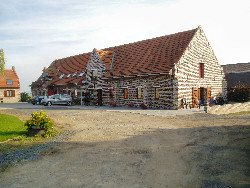 is artifact in
one of their barns, along with a small collection of such items which
they had found over the years in the fields of their farmland.
Everywhere there are such small private museums; shell cases, spent
bullets, hand grenades, tin helmets, decaying scraps of gas masks and
other military impedimenta, are on display in barns and sheds, where the
owners hope to make a little money from the war buffs and tourists, and
every village has a cemetery or even two with the rows of crosses and
gravestones.
is artifact in
one of their barns, along with a small collection of such items which
they had found over the years in the fields of their farmland.
Everywhere there are such small private museums; shell cases, spent
bullets, hand grenades, tin helmets, decaying scraps of gas masks and
other military impedimenta, are on display in barns and sheds, where the
owners hope to make a little money from the war buffs and tourists, and
every village has a cemetery or even two with the rows of crosses and
gravestones.