In south Somerset, as elsewhere, one effect of the
Black Death was the change from arable farming to less labour-intensive
sheep farming. By the end of the 14th century, Somerset was
producing about a quarter of English woollens and it was a time of great
prosperity. As the wool trade boomed during the 14th and 15th
centuries, a religious zeal swept the country in the wake of the Black
Death that was to last for some two hundred years. Also, local
populations were tending to increase in size and so, flushed with the
wealth of wool, began a phase of enlarging existing churches and St
Stephens was no exception.
A village of Saxon origin, the manor was held by the
Canons
of Wells Cathedral by the time of Edward the Confessor (c.1003 -
1066). It was seized briefly by Harold II but reverted back to
the Canons after the conquest.
|
Of the original ch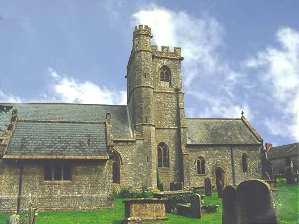 urch there is no trace but the present
fabric, with the unusual form of
nave and
chancel separated by a central
tower without transepts, is no doubt based on the Norman plan. At the beginning of the 13th century, the church and manor constituted a
provostship of Wells with the
provost having a house in Winsham. By 1234, because the Winsham lands were insufficient to maintain a
provost, it was united with the provostship of Combe St Nicholas. urch there is no trace but the present
fabric, with the unusual form of
nave and
chancel separated by a central
tower without transepts, is no doubt based on the Norman plan. At the beginning of the 13th century, the church and manor constituted a
provostship of Wells with the
provost having a house in Winsham. By 1234, because the Winsham lands were insufficient to maintain a
provost, it was united with the provostship of Combe St Nicholas.
It was probably at this time that the
chancel was extended to its present
size - evidenced by the slim, pointed Early English Gothic lancet
windows.
Since the chancel was the responsibility of the church while the nave
was the responsibility of the parish, it is unlikely that the
nave was
extended at the same time. The chancel continued to be altered
throughout the 13th and early 14th centuries as can be seen by the
elaborate tracery of two other windows in the
Decorated Gothic style.
In 1348, plague –
the "Black Death"
– reached England through Weymouth and recent research confirms that
about a third of the population of the known world perished. 50% of
beneficed clergy in Somerset died between October 1348 and April 1349.
Overshadowing the second half of the 14th century, the aftermath of the
Black Death saw little in the way of building works - not only had the
country lost many of its skilled artisans and builders but the high cost
of the remaining workforce was prohibitive for most recovering parishes. |
|
The 15th century saw a remodelling of the church fabric in the
Perpendicular Gothic
style
- showing today in the heightened central
tower, the ornate
wagon roof of the nave together with the large nave
windows, the font and the almost
unique
tympanum panel depicting the
Crucifixion.
|
The nave
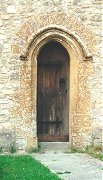
The nave is entered through the south porch with a good 15th
century wagon roof. The detached
vestry was built in 1929. The west
window of the nave is in the Curvilinear form of Decorated Gothic
style with simple recurving tracery and probably dates the nave to the early- to mid-14th
century. The other windows are later Perpendicular insertions of the 15th
century. The west door has been made into a window recently.
A tiny
hagioscope, or squint, in the south pillar of the tower suggests a
former south side altar in the nave. Above where this altar would have
been, the blocked rood loft doorway is visible.
The
wagon roof, probably
dating to the 15th century alterations, is ceiled with
contrasting structural members and has some fine gilded bosses including
a Tudor Rose and a portcullis. The Jacobean
pulpit is octagonal with
double Ionic columns at each angle with arabesque decoration to the
panels. The font is Perpendicular with
quatrefoil decoration,
cusping
below and panelling to the stem.
The tower base
The internal base of the tower was probably heightened as part of the
15th century alterations when the present Perpendicular
arches were inserted but the
corbel
heads in the chancel are much
earlier.
The tympanum panel is described above.
The oak
rood
screen is just pre-Reformation and probably dates to the late 1520's or
early 1530's and is similar in style to other early 16th century church
carving in the district. It is constructed with four-light side
sections with the central
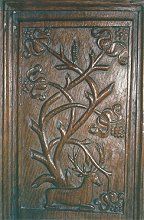
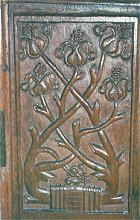
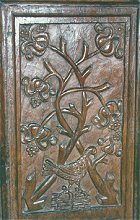
mullions extending to the apex. The lower
panels are carved both sides with mainly foliage work but also included
are a stag and a falcon on its nest of sticks. The latter was the heraldic badge
of Henry VII’s sister-in-law, Katherine, the Countess of Devon. The
screen has seen much restoration.
|
|
|
|
|
|
Carvings from the rood screen including
the Stag, the Barrel and the Countess of Devon's badge. |
|
|
|